Negative and positive rights
Rights obliging inaction or action, central to rights theory.

Chetvorno · CC0
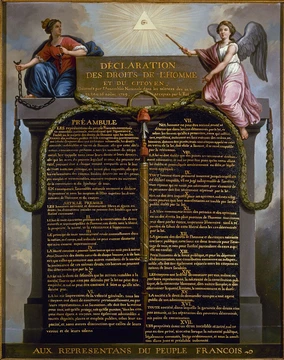
Negative and positive rights are a classification of rights that oblige either inaction (negative rights) or action (positive rights). These obligations may be of a legal or moral character. The distinction is often applied to liberty rights and is central to debates in political philosophy, particularly among libertarians who emphasize that positive rights do not exist until created by contract. The United Nations Universal Declaration of Human Rights lists both types without identifying them as such.
- field
- Political and legal philosophy
- known_for
- Distinction between negative rights (obliging inaction) and positive rights (obliging action)
- associated_concept
- Three generations of human rights (negative rights as first generation; positive rights as second and third)
Lore & Background
The notion of positive and negative rights may also be applied to liberty rights. Negative rights may include civil and political rights such as freedom of speech, life, private property, freedom from violent crime, protection against being defrauded, freedom of religion, habeas corpus, a fair trial, and the right not to be enslaved by another. Positive rights, a concept that dates back centuries in political philosophy, may include other civil and political rights such as the right to counsel and police protection of person and property, as well as economic, social and cultural rights such as food, housing, public education, employment, health care, social security, internet access, and a minimum standard of living.
Reader's Guide
The distinction between negative and positive rights is generally maintained or emphasized by libertarians, who believe that positive rights do not exist until they are created by a contract. The constitutions of most liberal democracies guarantee negative rights, but not all include positive rights; positive rights are often guaranteed by other laws. Some philosophers disagree that the negative–positive rights distinction is useful or valid. In practice, rights are often ranked by degree of importance, with negative obligations generally considered prima facie and junior to positive obligations. The conflict between these rights appears in medicine, where positive rights of patients may conflict with negative rights of physicians, as in cases of abortion and assisted suicide. Critics such as Ayn Rand implicitly suggest that because positive obligations are not reliably prima facie, they must always be agreed to through contract. The Soviet Union criticized the Universal Declaration of Human Rights for prioritizing negative rights over positive rights.
Did You Know?
- The distinction between negative and positive rights has been discussed in political philosophy for centuries, long before the 20th century.
- Negative rights may include freedom of speech, life, private property, and freedom from violent crime.
- Positive rights may include food, housing, public education, health care, and internet access.
- Libertarians hold that positive rights do not exist until they are created by a contract.
The Architecture of Obligation — Defining the Two Kinds of Rights
Negative rights oblige inaction; positive rights oblige action. This foundational split can be understood as a matter of legal or moral character, and it extends even to liberty rights. A negative right means someone must not act against you, typically in ways involving abuse or coercion by another person, group, or government. These rights persist by default unless someone actively negates them. A positive right, by contrast, requires another party to perform a specific action on your behalf. In the Kantian ethical vocabulary, negative rights map onto perfect duties—clear, binding prohibitions—while positive rights align with imperfect duties, which are more flexible and context-dependent. The three-generations model of human rights further codifies this split: first-generation rights lean negative, while second- and third-generation rights lean positive.
The Political Fault Line — Who Accepts Which Rights
The negative-positive divide has become a defining fault line in political philosophy. Libertarians, in particular, stress the distinction sharply, holding that positive rights simply do not exist until a voluntary contract brings them into being. In their view, a right to be protected by police is not an inherent entitlement but an obligation created when an officer contracts with an employer to defend citizens from violence. Meanwhile, the United Nations Universal Declaration of Human Rights enumerates both types of rights without explicitly labeling them, and the constitutions of most liberal democracies enshrine negative rights—freedom of speech, habeas corpus, fair trial, protection from slavery—while positive rights like publicly funded education, health care, and unemployment benefits are typically secured through separate legislation. Yet the distinction itself is not universally accepted. Some philosophers argue that separating rights into negative and positive categories is neither useful nor valid, challenging the very framework that has structured much of modern rights discourse.
When Rights Collide — Ethical Ranking and the Hierarchy of Obligations
Rights are often called inalienable, yet in practice societies operate under what amounts to graded absolutism: rights are ranked by importance, and violating a lesser right may be tolerated to prevent a greater one. The obligation not to kill, for instance, carries at least one widely recognized exception—self-defense. Negative obligations like refraining from murder or theft are typically treated as prima facie, meaning their legitimacy is accepted on its face, though they can still be ranked for deeper ethical analysis. Positive obligations, by contrast, are almost never regarded as prima facie in ethics. A triage scenario after a disaster, where a responder must choose among several injured children, illustrates why positive duties demand more complex reasoning. This has led ethicists to a broad consensus that positive obligations are generally junior to negative ones. Nineteenth-century thinker Frédéric Bastiat captured the tension vividly when he told Lamartine that legally enforced fraternity would destroy liberty and trample justice underfoot.
Enforcement, Monopoly, and the Contract Question
A common objection to the negative-positive distinction is that even negative rights require police and courts for enforcement, seemingly blurring the line. Jan Narveson pushes back firmly, calling this conflation mistaken. He argues that the question of what one has a right to do is entirely separate from whether anyone enforces it. If rights are purely negative, no one bears a duty to enforce them, but individuals retain the right to seek voluntary, non-forcible cooperation from others to protect those rights. Narveson insists the distinction is quite robust. Other defenders of the split point out that the existence of a police force or military is not the product of a positive right citizens claim, but rather a natural monopoly or public good that arises organically in any human society. Libertarians who deny positive rights do not deny that police are obligated to protect citizens; they simply locate that obligation in the contractual relationship between the officer and their employer, not in an inherent entitlement.
Gallery





Frequently Asked Questions
What are negative and positive rights in simple terms?
Negative rights require others to refrain from interfering with your freedoms, while positive rights require others to take active steps to provide something to you. This two-part classification is a foundational tool in political and legal philosophy for sorting what different rights actually demand.
What is the core difference between a negative right and a positive right?
The distinction hinges on the type of obligation created: a negative right obligates inaction (someone must not do something to you), whereas a positive right obligates action (someone must do something for you). Both can carry either legal or moral force depending on the context in which they are invoked.
How do negative and positive rights map onto the three generations of human rights?
In the three-generations framework, negative rights correspond to the first generation of civil and political liberties, while positive rights align with the second and third generations covering economic, social, and collective entitlements. This mapping helps trace how rights theory has broadened over time.
Why do libertarians dispute whether positive rights truly exist?
Many libertarians hold that positive rights have no natural standing and only come into being through voluntary contracts between individuals. This position sets them apart from broader political-philosophical traditions that treat positive rights as inherent or state-guaranteed.
Does the UN Universal Declaration of Human Rights label rights as negative or positive?
No—the Declaration lists both types of entitlements side by side without tagging which are negative and which are positive. Its neutral catalogue approach reflects a deliberate choice to present a unified set of human rights rather than a theoretical taxonomy.
More in Constitutional And Rights Law 1-19
Spotted an error? Know more?
This is a living reference — every entry is fact-audited, and reader corrections feed straight into our audit queue. Suggest an edit · See this site's audit record