Marbury v. Madison
Established judicial review in American constitutional law.

US Supreme Court. Calvin Ballantine at German Wikipedia · Public domain
Marbury v. This power allows American courts to strike down laws and statutes they find to violate the Constitution. The case originated from the rivalry between outgoing president John Adams and incoming president Thomas Jefferson, centering on undelivered judicial commissions from Adams's last days in office.
- Case
- Marbury v. Madison
- Court
- Supreme Court of the United States
- Chief Justice
- John Marshall
- Key Principle
- Judicial review
Lore & Background
The court held that Madison's refusal was illegal and that normally a court could order delivery, but it did not issue the writ. This established that American courts have the power to invalidate laws that violate the Constitution.
Reader's Guide
Marbury v. Madison is regarded as the single most important decision in American constitutional law. It established that the U.S. Constitution is actually law, not merely a statement of political principles and ideals. The decision also helped define the boundary between the constitutionally separate executive and judicial branches of the federal government. By asserting the power of judicial review, the Supreme Court positioned itself as a coequal branch capable of checking legislative and executive actions. The case remains foundational to the American legal system, cited whenever courts assess the constitutionality of statutes.
Did You Know?
- The case originated from the rivalry between outgoing president John Adams and incoming president Thomas Jefferson.
- William Marbury was a Maryland businessman and a strong supporter of Adams and the Federalist Party.
- The Supreme Court's opinion was written by Chief Justice John Marshall, who had been Adams's secretary of state.
The Political Storm Behind the Case
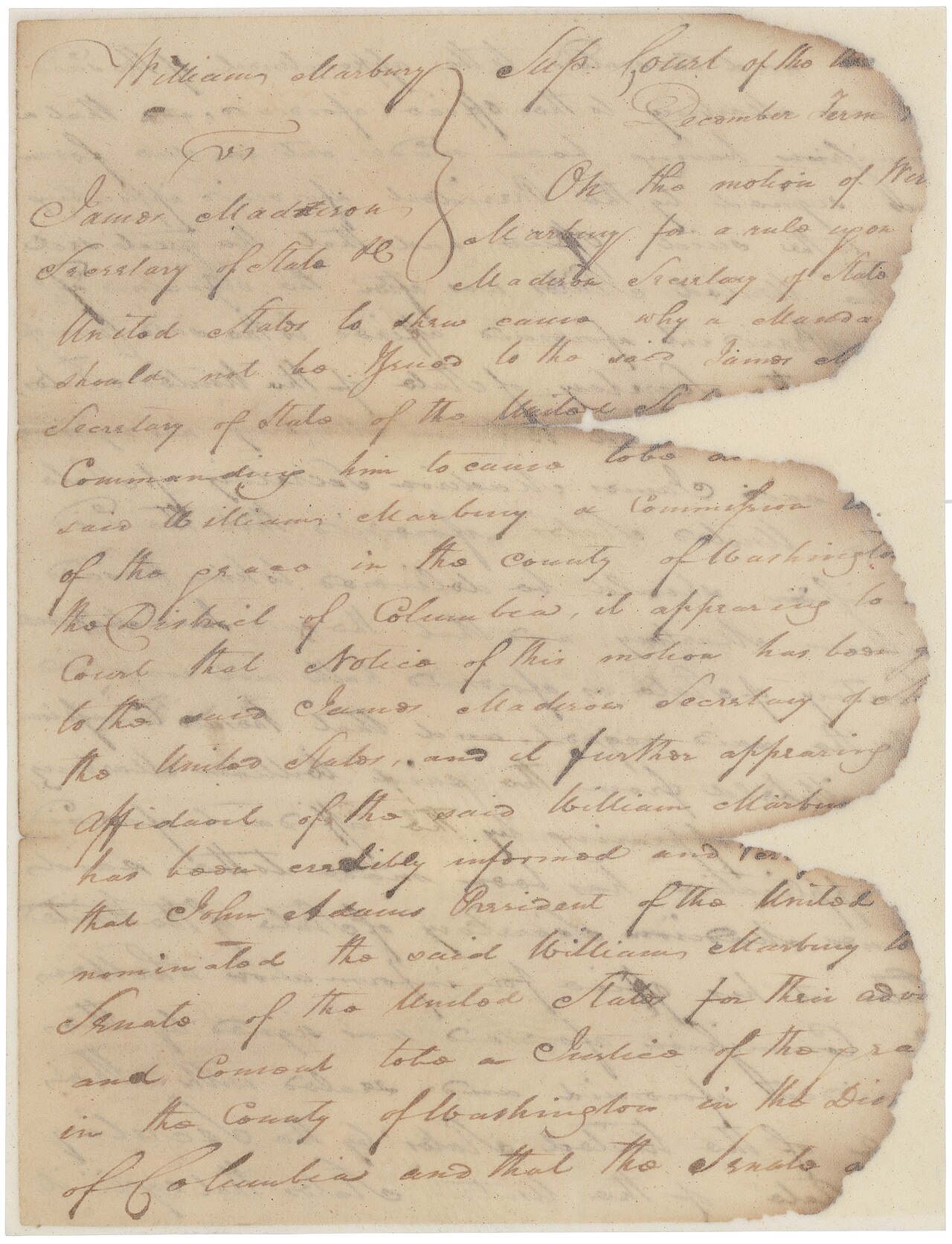
Public sentiment had turned against the Federalists, driven largely by the unpopular Alien and Sedition Acts and growing unease over the party's close ties to Great Britain. Jefferson won the popular vote and narrowly edged Adams in the Electoral College. Faced with imminent defeat, Adams and his Federalist allies moved quickly to entrench their influence in the federal judiciary. Jefferson's supporters sneered at them as the "Midnight Judges." Among them was William Marbury, a prosperous Maryland businessman and vocal Adams supporter. The Senate approved the slate en masse the next day, and Secretary of State John Marshall sealed the commissions. But with only hours remaining before Jefferson's inauguration, a handful of commissions—including Marbury's—never reached their recipients. Jefferson, convinced the undelivered papers were legally void, ordered his new secretary of state, James Madison, to withhold them. After months of steadfast refusal, Marbury took his grievance to the Supreme Court.
The Court's Three-Question Architecture
Rather than addressing the dispute in a single sweeping paragraph, Marshall organized his reasoning around three sequential questions the Court answered one by one. The first asked whether Marbury possessed a legal right to the commission he had been promised. The Court answered yes. The second probed whether, given that right, the law provided a remedy to enforce it. Here too the Court said yes, noting that in ordinary circumstances a court would properly order a government official to hand over a valid commission. The third and decisive question asked whether the Supreme Court itself held the authority to issue the writ of mandamus Marbury sought. Marshall concluded that this provision stretched the Court's constitutional authority beyond the boundaries originally set forth in the Constitution. Because the statute was invalid, the Court lacked jurisdiction and therefore could not grant the writ.
The Birth of Judicial Review
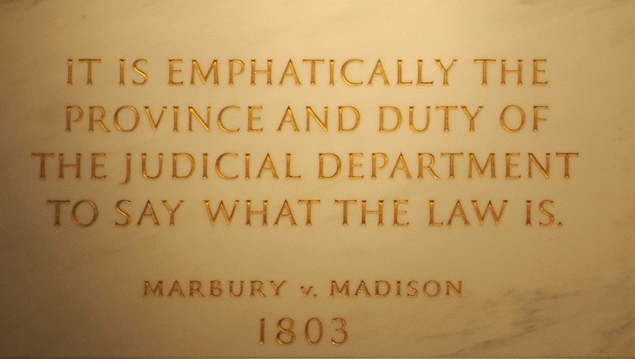
By declaring section 13 of the Judiciary Act unconstitutional, the Court announced for the first time that American courts possess the authority to invalidate statutes they determine conflict with the Constitution. This power, now universally called judicial review, transformed the Constitution from what Marshall implied was merely a declaration of political ideals into a binding legal instrument enforceable by the judiciary. The decision also drew a clearer boundary between the constitutionally separate executive and judicial branches, clarifying where one branch's authority ended and the other's began. Scholars and legal historians have consistently ranked Marbury v. Madison as the single most important decision in the history of American constitutional law. The principle it established—courts as guardians of constitutional supremacy over legislative enactments—has remained a foundational pillar of the American legal system ever since, shaping how every subsequent generation of judges interprets the relationship between statute and constitution.
Marshall's Ironic Masterstroke
There is a striking layer of personal irony at the heart of the case. The very official who had failed to deliver Marbury's commission while serving as Secretary of State was the same John Marshall who, now elevated to Chief Justice, authored the Court's opinion. Marshall acknowledged in his ruling that Madison's refusal to deliver the commission was unlawful and that, under normal circumstances, a court would order the official to comply. Yet Marshall then deftly sidestepped the practical problem: by striking down the statutory provision that gave the Supreme Court original jurisdiction over mandamus actions, he removed the Court's own power to issue the very writ Marbury had requested. The result was a ruling that simultaneously denied the petitioner his remedy while granting the judiciary a far more powerful tool—the ability to nullify acts of Congress. Marshall thus turned a narrow administrative dispute into a permanent structural feature of American government, all while the practical outcome was that neither Marbury received his commission nor was Madison ordered to act. The Court lost the case on its surface but won the constitutional argument that would define its role for centuries.
Gallery

Frequently Asked Questions
What is Marbury v. Madison?
Marbury v. Madison is a landmark 1803 Supreme Court case in which Chief Justice John Marshall declared that federal courts hold the authority to invalidate legislation that conflicts with the Constitution. It remains the foundational precedent for the doctrine of judicial review in American law.
Who wrote the Marbury v. Madison opinion?
Chief Justice John Marshall authored the unanimous opinion. He had just been elevated to the bench by the very administration at the center of the dispute, which made the ruling politically delicate.
What is the key principle established in Marbury v. Madison?
The case established judicial review, meaning the judiciary can examine and overturn statutes or executive actions that violate the Constitution. This gave the courts a genuine check on the other two branches of government.
What events led to Marbury v. Madison?
In the final days of John Adams's presidency, he signed judicial commissions that were never delivered before Thomas Jefferson took office. William Marbury, one of the commissioners who never received his appointment, petitioned the Court for a writ of mandamus to force delivery.
Why is Marbury v. Madison so important to constitutional law?
It cemented the Supreme Court's role as the ultimate interpreter of the Constitution, granting the judiciary the power to strike down laws it deems unconstitutional. Without this precedent, the system of checks and balances among the three branches would lack a critical enforcement mechanism.
More in Constitutional And Rights Law 1-19
Spotted an error? Know more?
This is a living reference — every entry is fact-audited, and reader corrections feed straight into our audit queue. Suggest an edit · See this site's audit record