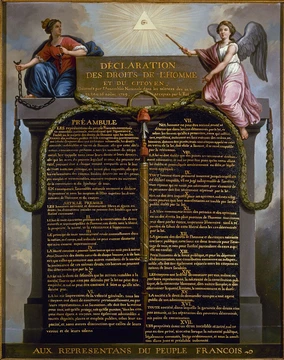
Natural rights and legal rights
Two categories of rights: universal natural rights and system-dependent legal rights.

Orqanisation of the Islamic Conference · Public domain
Natural rights and legal rights are two categories of rights distinguished by some philosophers. Natural rights are universal, fundamental, and inalienable, not dependent on any particular culture or government, while legal rights are bestowed by a given legal system and can be modified or repealed by human laws. The distinction has shaped debates about justice, government legitimacy, and human rights.
- field
- Philosophy of law, political philosophy
- known_for
- Distinction between natural rights (universal, inalienable) and legal rights (granted by legal systems)
- key_concepts
- Natural law, positive law, iusnaturalism, human rights
- historical_roots
- Ancient Greek philosophy, Stoics, Cicero, Saint Paul, medieval Catholic philosophers
- major_thinkers
- Albert the Great, Thomas Aquinas, Jean Gerson, John Locke, Immanuel Kant, Jeremy Bentham
Lore & Background
The concept of natural law first appeared in ancient Greek philosophy and was later articulated by the Roman philosopher and statesman Cicero. Conversely, the concept of natural rights is used by others to challenge the legitimacy of all such establishments.
Reader's Guide
The distinction between natural and legal rights is significant because it underpins debates about the foundation of human rights and the legitimacy of laws. The idea of human rights derives from theories of natural rights, though some reject a distinction between them. Iusnaturalism holds that legal norms follow a human universal knowledge, viewing enacted laws that contradict such knowledge as unjust. However, the concept of natural rights is not universally accepted, partly due to its religious associations and perceived incoherence; some philosophers, like Jeremy Bentham, called natural rights 'simple nonsense.' The existence of natural rights has been asserted on different premises, such as a priori philosophical reasoning (e.g., Immanuel Kant) or religious principles (e.g., the U.S. Declaration of Independence). Different philosophers have designed different lists of natural rights, almost all including the right to life and liberty as the two highest priorities.
Did You Know?
- The negative/positive rights distinction is a modern debate; many philosophers and traditions include positive rights within natural rights, not just negative ones.
- Jeremy Bentham called natural rights 'simple nonsense.'
- John Locke emphasized 'life, liberty and property' as primary natural rights, while Thomas Jefferson substituted 'pursuit of happiness' in the U.S. Declaration of Independence.
The Two Faces of a Right: Claim Versus Liberty
Philosophers and political scientists working in the tradition of legal analysis have long recognized that the word 'right' carries at least two distinct meanings. In one sense, a right is a claim: it imposes genuine duties, responsibilities, or obligations on other people toward the person who holds it. In the other sense, a right is a liberty: it grants the holder freedom or permission without demanding anything specific from anyone else. The practical difference is substantial. A liberty right to an activity simply means the agent is free to pursue it, whereas a claim right to that same activity means others are bound to permit or facilitate it. This bifurcation clarifies debates that would otherwise remain muddled, because it forces the question of whether a given right is merely about non-interference or whether it actively commands something of the wider community. Recognizing which sense is at work transforms how we evaluate the scope and enforceability of rights in both moral and legal discourse.
Hohfeld and the Architecture of Legal Reasoning
His contribution was not merely terminological; it gave courts, scholars, and legislators a structured grammar for dissecting judicial reasoning and for identifying exactly which party bears which obligation or enjoys which permission. The framework has endured as a cornerstone of legal philosophy, appearing in major reference works such as the Stanford Encyclopedia of Philosophy and the Internet Encyclopedia of Philosophy. Subsequent writers, including Professor William E. May, have built on Hohfeld's distinctions to explore the boundary between rights and mere liberties, ensuring that his analytical system continues to shape how the architecture of rights is understood across constitutional, moral, and economic contexts.
Logical Inversion and the De Morgan Structure
A striking feature of the claim-and-liberty framework is that the two concepts stand in a strict inverse relationship to one another. An individual enjoys a liberty right to perform an action precisely when no other individual holds a claim right that forbids that action. Symmetrically, the moment one person acquires a claim right directed at another, the second person's liberty in that domain is curtailed. This mirroring is not accidental; it rests on a deep logical principle known as De Morgan duality in deontic logic. Under this principle, permission and obligation are duals: a person is permitted to do exactly and only those things they are not obliged to avoid, and they are obliged to do exactly and only those things they are not permitted to avoid. The consequence is that every strengthening of a claim right mechanically narrows someone else's liberty, and every broadening of liberty relaxes a corresponding claim. The structure is exhaustive and symmetrical, leaving no gap between what is permitted and what is required.
Powers, Immunities, and the Second-Order Layer
Hohfeld's analytical system extends beyond the first-order pair of claims and liberties to encompass two further categories that operate at a higher level of abstraction. He identified powers and immunities as the second-order counterparts. A power is a second-order liberty: it is the freedom or permission to create, modify, or extinguish first-order rights. An immunity, by contrast, is a second-order claim: it is the obligation on others not to alter or interfere with one's existing first-order rights. This layering reveals that rights are not static entitlements but dynamic structures capable of being reshaped. One person may hold the power to transfer a claim, while another person may possess an immunity that shields that claim from alteration by a third party. Together, the four categories—claims, liberties, powers, and immunities—constitute what is commonly called the Hohfeldian analytical system, offering a comprehensive grammar for describing the full spectrum of legal and moral relationships among agents.
Gallery


Frequently Asked Questions
What is the actual difference between natural rights and legal rights?
Natural rights are treated as universal, inalienable entitlements that belong to every person regardless of culture or government, while legal rights are specific grants created by a particular legal system and can be amended or repealed by legislation. The practical upshot is that one category is seen as pre-existing human authority and the other as wholly dependent on it.
Who are the major thinkers behind the natural rights vs legal rights distinction?
The lineage runs from the Stoics and Cicero through medieval Catholic philosophers like Thomas Aquinas and Jean Gerson, and into modern minds such as John Locke, Immanuel Kant, and Jeremy Bentham. Each figure refined how universal moral claims relate to the positive, enacted law of a given state.
Where does the idea of natural rights vs legal rights come from historically?
It originates in Ancient Greek and Stoic philosophy, which held that a rational moral order underlies all societies, and was further shaped by Cicero, Saint Paul, and medieval Catholic thought. The framework then became a cornerstone of Enlightenment political philosophy and modern human-rights discourse.
Why does this distinction matter for constitutional and rights law?
It frames the core question of whether a legislature's power to grant or restrict rights is legitimate, and whether certain fundamental freedoms exist independently of any statute. That tension drives debates over judicial review, the scope of human rights, and the proper limits of governmental authority.
Can a government legally override or repeal a natural right?
Within the natural-rights tradition the answer is no, because those rights are inalienable and do not depend on any legal system for their existence. In practice, however, positive law can constrain how natural rights are exercised, and that gap between the two categories is precisely what fuels ongoing disputes about justice and state legitimacy.
More in Constitutional And Rights Law 1-19
Spotted an error? Know more?
This is a living reference — every entry is fact-audited, and reader corrections feed straight into our audit queue. Suggest an edit · See this site's audit record