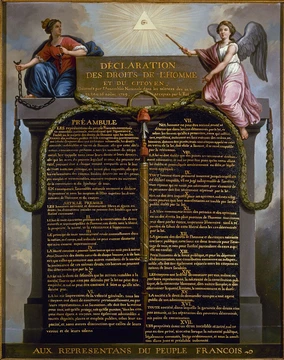
Limited government
Government power restricted by law and consent.

Arafath1019 · CC0
Limited government is a concept in political philosophy describing a government whose powers are restricted, typically by a constitution or a social contract. It is a key concept in the history of liberalism and a core tenet of democracy, often involving the protection of individual liberty from government intrusion.
- earliest_use_of_term
- Mid-17th century, by Levellers or John Locke
- key_historical_documents
- Magna Carta, U.S. Constitution, English Bill of Rights
- modern_measurement
- World Justice Project Rule of Law Index (tracks checks on government powers globally)
Lore & Background
The earliest use of the term 'limited government' is commonly traced to political philosophers such as John Locke or the Levellers in the mid-17th century, not to King James VI and I. Scholar Steven Skultety argues that Aristotle's political philosophy in some ways anticipated the idea of limited government, primarily as a tool for limiting civic distrust and enhancing stability, though Aristotle never developed principles and tactics of constitutionalism. John Locke, a liberal philosopher, was an important theorist of modern democratic government. In his Two Treatises of Government, Locke reasoned that men in a state of nature would voluntarily form a government via social contract, and that government powers must be restricted to only what the people allow. Modern summaries of his thought often highlight limitations such as governing only according to promulgated established laws with equality under the law; laws designed only for the common good; no taxation without representation; and no delegation of law-making authority without the people's consent, though Locke did not present these as a formal canonical list.
Reader's Guide
Limited government is closely associated with constitutions and constitutionalism. The U.S. James Madison wrote in Federalist No. 51 that security against concentration of powers requires giving each department constitutional means and personal motives to resist encroachments. Amy Gutmann notes that negative liberalism, positive liberalism, and democratic liberalism advance different conceptions of proper limits. She defends democratic liberalism, arguing government should be limited only as needed to secure basic liberties and opportunities and to respect fair democratic procedures consistent with constitutional constraints.
Did You Know?
- The earliest use of the term 'limited government' is commonly traced to mid-17th century political philosophers such as John Locke or the Levellers.
- John Locke's fourth limitation on government power held that the legislature could not delegate law-making authority to any other power without the people's consent.
- The U.S. Constitution achieved limited government through both horizontal separation of powers (among branches) and vertical separation of powers (federalism).
- The World Justice Project Rule of Law Index tracks checks on government powers globally, though claims about specific year-to-year erosion percentages vary by report.
The Architecture of Constitutional Rights
Constitutional rights occupy a unique position in the legal landscape of any sovereign state. They can function as a prerogative granted to citizens, a duty imposed upon them, a power wielded by government, or a restraint limiting governmental power. Whether expressly written into a national constitution or inferred from its broader language, these rights derive their authority from the constitution's status as the supreme law of the land. Any statute that contradicts constitutional provisions is rendered unconstitutional and invalid. Typically, a constitution maps out the structure, functions, and limits of national government while simultaneously enumerating the individual freedoms and obligations that national authorities must protect and enforce. Today, the vast majority of nations maintain a written constitution that articulates similar or distinct sets of rights.
The American Federal Framework and Selective Incorporation
Over the following two centuries, seventeen additional amendments were added, bringing the total to twenty-seven amendments alongside seven articles. Crucially, the Bill of Rights originally constrained only the federal government. Through a process called selective incorporation under the Due Process Clause of the Fourteenth Amendment, most of these provisions gradually became binding on the states as well. Once incorporated, a state can no longer restrict the guaranteed right. City of Chicago, while the Fifth Amendment's grand jury guarantee was never incorporated, meaning state criminal defendants have no federal constitutional right to grand jury proceedings.
State Constitutions and the Broader Protection Principle
Each of the fifty U.S. states maintains its own governing constitution, and these documents tend to be substantially longer and more detailed than the federal charter. This divergence reflects what Justice Brennan termed the new judicial federalism: state constitutions may grant citizens broader protections than the federal document, but they can never narrow those federal guarantees. As established in California v. State constitutions can also enshrine rights entirely absent from the federal framework, such as the right to adequate education or the right to affordable housing. Legal professionals further distinguish between process rights, which govern the powers and obligations of government toward individuals, and substantive rights, which encompass the individual freedoms that governments are charged with protecting rather than granting.
Global Constitutional Rights and Their Practical Limits
Constitutional rights vary considerably across the world. Nations like Germany, India, and Japan include explicit bills of rights in their written constitutions. Across the Council of Europe, the European Convention on Human Rights provides a supranational layer of protection, allowing individuals who have suffered rights violations on the territory of signatory nations to appeal to the European Court of Human Rights. In authoritarian regimes, guaranteed inalienable rights are generally few or nonexistent; where they do appear in legal texts, they frequently remain unobserved in practice, as was the case in the former Francoist Spain.
Gallery






Frequently Asked Questions
What is Limited government?
Limited government is a political-philosophy principle holding that a state's authority must be constrained—usually by a constitution or a social contract—so that individual liberty is shielded from unchecked state intrusion. It is a cornerstone of liberal thought and democratic practice.
Who first used the term 'Limited government'?
The phrase dates to the mid-17th century and is most often attributed to either the Levellers or John Locke, both of whom argued that rulers must operate within legal boundaries set by the governed rather than by their own will.
Which historical documents are most closely tied to Limited government?
The Magna Carta, the English Bill of Rights, and the U.S. Constitution are the landmark texts most frequently cited as foundational expressions of the idea that governmental power must be legally bounded and consent-based.
How is Limited government measured in the modern world?
The World Justice Project's Rule of Law Index serves as the primary contemporary benchmark, tracking how effectively different nations impose institutional checks on their own government's powers.
Why is Limited government important to rights law?
It provides the philosophical and legal foundation for keeping state power subordinate to law and popular consent, which in turn makes the protection of individual rights against government overreach a structural feature of the system rather than a mere courtesy.
More in Constitutional And Rights Law 1-19
Spotted an error? Know more?
This is a living reference — every entry is fact-audited, and reader corrections feed straight into our audit queue. Suggest an edit · See this site's audit record